
Why It Matters
The Challenges of Life After Service
Every service member who returns home deserves the opportunity to build a successful and fulfilling future. Yet for many Veterans, the transition from military service to civilian life comes with significant challenges.
At The Patriot Fund, our mission is driven by a deep commitment to those who have served. Our volunteer team generously contributes its time, expertise, and professional networks to help Veterans overcome obstacles and achieve lasting success.
Many of the leaders who guide our organization are Veterans themselves. Their first-hand experience provides invaluable insight into the realities of military service and the challenges that can follow deployment. Their perspective shapes everything we do.
Behind every statistic is a Veteran and a story. The issues Veterans face after returning home are real, widespread, and often life changing. By understanding these challenges, we can better appreciate why our work is so important.
The information that follows highlights the realities many Veterans encounter and why The Patriot Fund remains dedicated to supporting those who have sacrificed so much for our country.
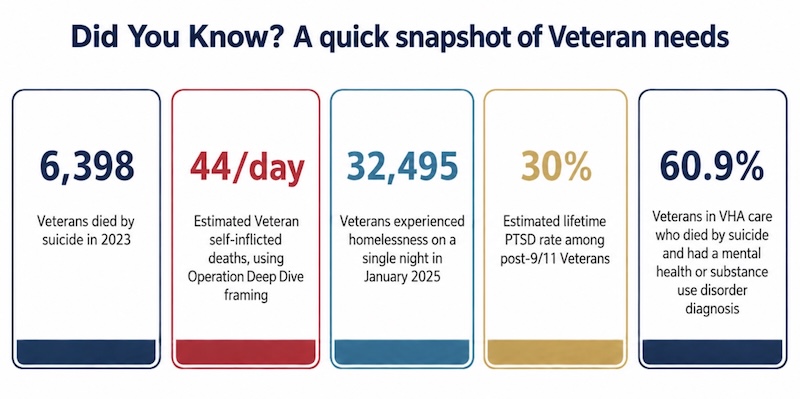
DID YOU KNOW?
- Suicide
- Homelessness
- Mental Health and Substance Use
- Post-Traumatic Stress Disorder (PTSD)
- Military Sexual Trauma (MST)
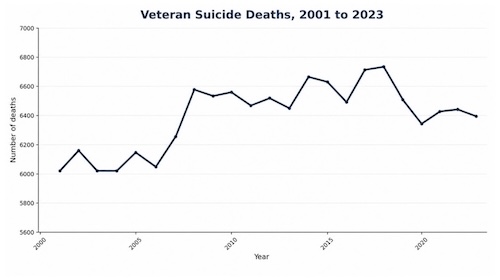 Suicide Among Veterans
According to the Department of Veterans Affairs 2025 National Veteran Suicide Prevention Annual Report, which studied calendar year 2023, there were 6,398 Veterans that died by suicide as officially classified in mortality records.
Operation Deep Dive, a research initiative led by America’s Warrior Partnership in partnership with Duke University, is studying other non-natural causes of deaths, including overdose, asphyxiation, accidental gunshot, drowning, suicide by law enforcement interaction, and high speed single driver accidents. Their work indicates the number of Veterans who take their own lives each year may be 2.4 times greater than previously reported by the VA. This means 44 deaths by suicide every day…one suicide every 32 minutes.
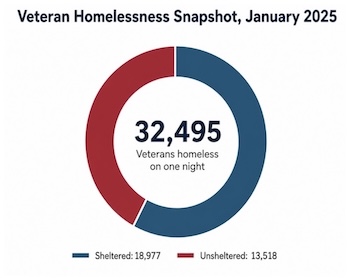 Veteran Homelessness
The 2025 Annual Homelessness Assessment Report to Congress prepared by the U.S. Department of Housing and Urban Development (HUD), states there were 32,495 Veterans living in Emergency Shelter, Transitional Housing, and Unsheltered Locations during a single night at the end of January 2025. Over the course of a year, that’s equivalent to 11.9 million nights of homelessness. Of those, almost 42% were unsheltered. For the men and women who have served our nation, that’s 5 million nights, annually, sleeping in places not meant for human habitation such as on the streets, in abandoned buildings, bus stations, or in their cars.
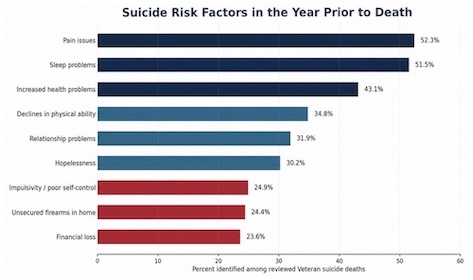 Mental Health, Wellbeing, and Substance Use
The VA’s 2025 National Veteran Suicide Prevention Annual Report shows a clear connection between suicide risk, mental health, wellbeing and substance use. Among Veterans in the VA’s care who died by suicide, 60.9% had a diagnosis of a mental health or substance use disorder. Contributing risk factors included pain issues, difficulty sleeping, health problems, physical disability, relationship problems, housing challenges, and financial strain. This illustrates why effective Veteran support cannot treat mental health, substance use, trauma, isolation, pain, housing instability, and financial strain as separate issues.
Veterans have earned and deserve readily available access to a wealth of services and programs that meet the whole-person needs for a full an fulfilling life before crisis becomes tragedy.
 Veteran PTSD
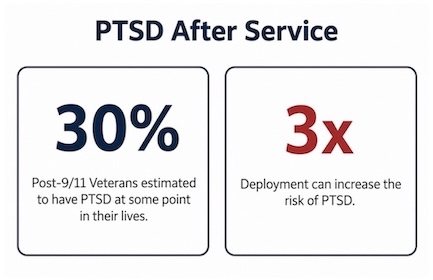
The VA’s National Center for PTSD estimates about 30% of post-9/11 Veterans have PTSD at some point in the lives. Research shows that deployment can increase the risk of PTSD by 3 times. Some factors in a combat situation may contribute to PTSD and other mental health problems, including military occupation or specialty, the politics around the war, where the war was fought, and the type of enemy faced.
 Military Sexual Trauma (MST)
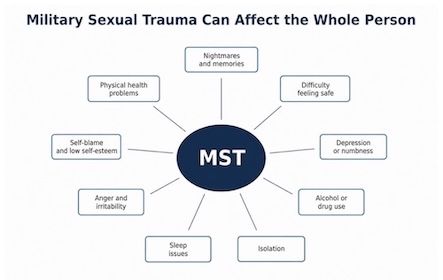
MST refers to sexual assault or threatening sexual harassment experienced during military service. Anyone can experience MST, regardless of age, sex, sexual orientation, racial or ethnic background, or branch of service. Like other types of trauma, MST can have a lasting impact on someone’s mental and physical health. Those coping with MST may experience disturbing memories or nightmares, difficulty feeling safe, feelings of depression or numbness, alcohol or other drug use to numb or escape from negative feelings, feelings of isolation from other people, issues with sleep, physical health problems, difficulty with anger, irritability, or other strong emotions, such as self-doubt, self-blame, and decreased self-esteem.
Patriot Fund commitment
At The Patriot Fund, we are committed to ensuring that no Veteran faces the potential challenges of acclimating to civilian life alone.
Supporting the work of the US Department of Veterans Affairs and our trusted network of Operational Partners, we help Veterans with the care, resources and support they need to overcome challenges and build brighter futures.
By funding early intervention, access to critical services, and long-term support, we help improve lives, strengthen families, and create lasting change in the communities our Veterans call home.
Through these efforts, we are confident we can help save Veteran lives and create lasting positive impacts for their spouses, children, families, and friends.